Network Technology


Generating programmable time delay from nanoseconds to milliseconds is important for various applications ranging from data center testing to wireless communications to radar, optical communications, and measurement systems.
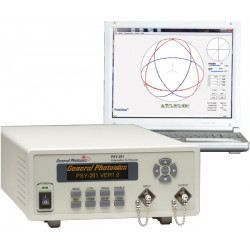
The PSY-201 is a deterministic polarization controller that can generate and maintain any state of polarization (SOP), regardless of the input SOP. It combines General Photonics’ patented polarization controller, in-line polarimeter, and control algorithm into an instrument that functions as both a polarization state generator and a polarization analyzer.

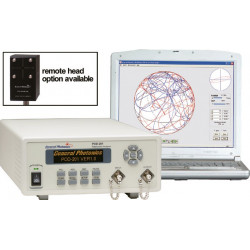
The POD-201 is an FPGA powered polarimeter specially designed for high-speed polarization analysis and monitoring. The instrument uses four channels to simultaneously obtain the four Stokes parameters and measure the instantaneous state of polarization (SOP) and degree of polarization (DOP) of an input light beam.
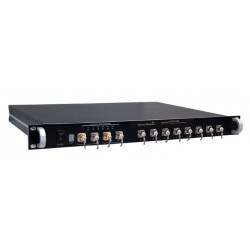
The OCA-1000 is a multi-channel optical component analyzer capable of performing simultaneous insertion loss (IL), polarization dependent loss (PDL), and optical power (P) measurements on multiple optical paths.

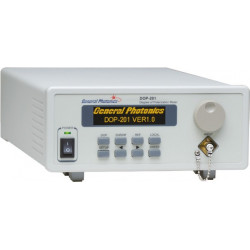
The DOP-201 measures and displays the Degree of Polarization (DOP) of a light source in real time with high accuracy and wide dynamic range.

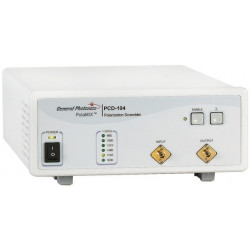
GPCs' Polarization Scrambler uses a breakthrough all-fiber technology to effectively randomize polarization states. Depolarizing by polarization scrambling has many important applications.
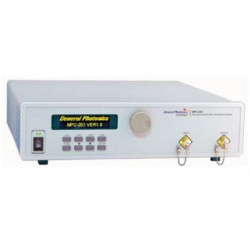
The MPC-203 is a special version of GPCs’ Multifunction Polarization Controller which can reach extremely high rates of polarization change. It combines PolaRite™ II/III polarization controller with proprietary polarization control algorithms to achieve a wide range of polarization control functionalities.

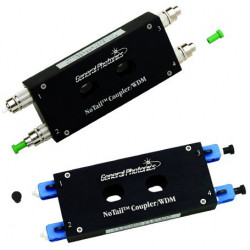
These connectorized couplers are free of fiber pigtails and ready to be inserted in optical systems without the headaches of tinkering with fragile and messy fiber pigtails.

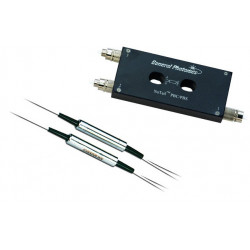
This device can be used either as a polarization beam combiner to combine light beams from two PM input fibers into a single output fiber, or as a polarization beamsplitter to split light from an input fiber into two output fibers of orthogonal polarization states.